
5 checks for towing a heavy boat safely downhill
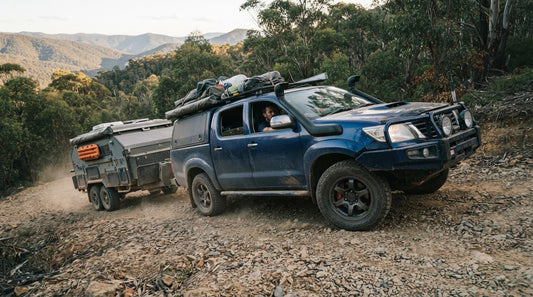
A vehicle can be within its towing limits and still be unsafe on a steep descent. Brake fade when towing a heavy boat depends on your whole setup and how you control the descent. This guide covers five practical checks, including how to recognise brake fade and respond safely.
Key Takeaways
- Match the fully loaded boat and trailer to every vehicle rating, and confirm the trailer brakes suit its mass.
- Keep heavy items low and close to the axle for stability.
- Leave extra space and manage speed early.
- Select a low gear before descending so engine braking does the work.
- Act on any change in braking feel, and stop safely if the brakes overheat.
1. Match Your Tow Vehicle to the Boat and Trailer Weight
Assess the boat and trailer fully loaded, not empty. Include fuel, batteries, safety gear and accessories. Compare the loaded combination against your vehicle’s towing capacity, gross vehicle mass (GVM), gross combination mass (GCM) and maximum tow-ball load. Each rating is a separate limit, so meeting one doesn’t mean you meet the others.
Trailer brake requirements in Australia depend on gross trailer mass (GTM):
| GTM | Braking requirement |
|---|---|
| 0-750 kg | No brakes required |
| 751-2,000 kg | Efficient brakes on both wheels of at least one axle |
| 2,001-4,500 kg | Efficient brakes on all wheels, plus an automatic breakaway system |
Trailer brakes must be operable from the driver’s seat. Override brakes activate when the trailer pushes forward under braking, while electric and electric-hydraulic systems use a brake controller.
Load placement affects stability. Aim for tow-ball weight of roughly 5% to 10% of the trailer’s loaded mass, with about 60% of the weight forward of the axle centre. A level or slightly nose-down drawbar helps. Too little tow-ball weight or a rear-heavy load can cause trailer sway.
Test before you go. On flat ground at low speed, check the controller responds steadily. If the trailer pushes the vehicle, slightly increase brake-controller gain. If the wheels lock or braking feels grabby, slightly reduce it. Make small changes and retest.
2. Following Distance, Speed and Slow Vehicle Bays
A boat trailer adds mass and momentum, so you need more room to stop.
- Keep at least a 4-second gap, and increase it in rain, poor visibility or with a heavy load.
- Treat 90-100 km/h as a recommended towing speed, never a licence to exceed posted limits.
- Use slow vehicle bays when a queue forms behind you.
- Plan breaks about 50% earlier than usual, and stop on level, safe ground.
- At each stop, check the coupling, straps and boat position.
Safety chains: loaded trailers under 2,500 kg need at least one compliant chain. Over 2,500 kg, two crossed chains are required. Chains keep the trailer connected but don’t shorten stopping distance.
3. Use Engine Braking on Steep Descents
Select a lower gear before the descent, while the vehicle is steady. A good starting point is the gear you’d use to climb the same hill, often 2nd or L. Automatics may have a low-range or manual mode, so check your owner’s manual.
- Don’t rely on cruise control on a steep grade.
- Avoid riding the brakes, as constant friction builds heat and reduces effectiveness.
- If engine braking isn’t enough, use stab braking: brake firmly for 3 to 5 seconds, then release fully for 10 to 15 seconds while the low gear holds speed.
- Slow before bends rather than braking hard mid-corner.
If the descent becomes unsafe, stop in a suitable area clear of traffic.
4. What Causes Brake Fade When Towing?
Brake fade happens when repeated or prolonged braking generates heat faster than the brakes can shed it, reducing braking power. Common contributors include:
- Heavy loads and frequent speed corrections
- Poorly adjusted or underperforming trailer brakes, which push more work onto the tow vehicle
- Dragging brakes that build heat before the descent begins
- Continuous light pedal pressure
5. Brake Fade Warning Signs and How to Respond
Don’t wait for a dashboard warning. Watch for:
- A soft pedal or longer pedal travel
- Needing more pressure to slow down
- A burning smell or smoke near a wheel
- The vehicle pulling to one side
- Pedal vibration or unusual noise
If braking weakens:
- Stay calm and steer smoothly.
- Ease off the accelerator and select a lower gear.
- Brake carefully, without constant pressure.
- Move to a safe stopping area and use hazard lights if needed.
- Don’t touch hot wheels or rotors, and never pour water on hot brakes, as rapid cooling can damage components.
- Allow severely overheated brakes to cool for 30 minutes or more.
Cooling alone doesn’t prove the system works. If the pedal still feels abnormal, braking is weak or the vehicle pulls, don’t resume towing. Have the brakes assessed first. Note the grade, load, weather and what you felt, as this helps identify the cause.
When to Replace Brake Parts
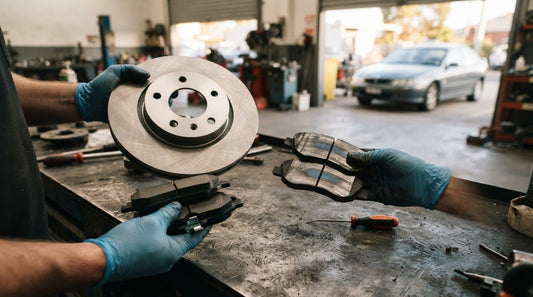
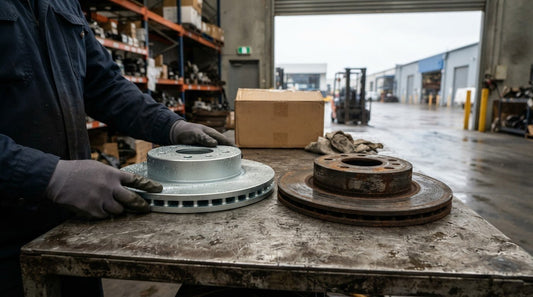
If an inspection finds worn or damaged components, replacement parts may be part of the repair. Canton Auto Parts supplies new braking system parts, control arms, alternators and starter motors. Match any replacement to your vehicle and the specific part needed. A parts supplier can’t diagnose brake fade, so resolve any safety concern before returning to a steep descent. Contact Canton Auto Parts for replacement parts for your vehicle.
Frequently Asked Questions
Can my vehicle tow this boat?
Only if the fully loaded combination stays within every applicable rating: towing capacity, GVM, GCM and tow-ball load. Include passengers, luggage and accessories. If any rating would be exceeded, reduce the load or use a suitable combination.
How should I distribute the weight?
Keep heavy items low and near the axle, and secure gear so it can’t shift. Recheck after adding or moving equipment, as relocating a battery or anchor can shift weight behind the axle.
What causes brake fade when towing a heavy boat downhill?
Repeated or continuous braking builds heat and reduces effectiveness. A heavy combination increases the workload, and a trailer brake fault can add more.
How do I prepare before a steep descent?
Check the route for advisory signs, bends and roadworks, and consider weather and traffic. Test the brakes at low speed on level ground and confirm the trailer is secure. If you notice pulling, grabbing or weak braking, don’t start the descent.
What gear and speed should I use?
No single answer fits every setup. Choose a lower gear before the slope, guided by your handbook and the grade, and stay below posted limits. Slow further in wet or low-visibility conditions.
How should I adjust and test trailer brakes?
Test on flat ground at low speed. Increase controller gain if the trailer pushes the vehicle, and reduce it if the wheels lock. Never adjust the controller mid-descent.
What should I do if the brakes start to fade?
Slow smoothly, use a lower gear, find a safe place to stop and let the brakes cool for 30 minutes or more. Don’t continue if braking is still abnormal.
How do boat weight and GCM affect downhill towing?
Everything you load uses part of your GCM allowance. A heavier combination demands more from the brakes, so check each rating separately against actual loaded weights.
Plan Your Next Descent
Before the trip, decide that if the route, load or braking response doesn’t feel right, you’ll stop somewhere safe rather than commit to a steep descent. Use a low gear, avoid riding the brakes, and treat any change in braking as a reason to take care.
Tags:
Previous
Replacing Heavily Scored Brake Discs: Compare Machining and Replacement Costs
Next
Buying Car Parts Online vs Local Auto Wreckers: Which Costs Less